
What EMDR Is Actually Like, From the First Session to the Last
People rarely ask me whether EMDR works. The research on that question is fairly settled, and most people who reach out have already read enough of it to be here. What they ask instead, usually in the first five minutes of a consultation call, is some version of: what actually happens? Do I have to tell you the whole story? Will I lose control of myself in your office? Is this the thing with the eyes?
Those are better questions, and they deserve a real answer rather than a brochure. So this is the whole arc, as honestly as I can render it: what the first sessions look like, what reprocessing is like from the inside, what the week after tends to bring, and how you know when a memory is done.
If you want the clinical overview first, our EMDR therapy page covers the eight phases, the evidence base, and what EMDR is used for. This essay is the view from the chair.
Nothing moves for the first few sessions, and that is on purpose
The most common misunderstanding about EMDR is that it starts with the eye movements or another type of bilateral stimulation. It does not. In a properly run course of EMDR, the first sessions contain no reprocessing at all.
We spend that time on two things. The first is history: what happened, when, what came before it, and what your life was organized around while you were surviving it. This is not a formality. EMDR targets specific memories, and choosing the wrong target is the difference between a session that opens something and a session that spins. Often the memory a person arrives naming is not the one carrying the weight. Someone comes in for a car accident and we discover the accident was unbearable partly because it landed on top of a childhood in which no one came when they were hurt.
The second is preparation, which is the phase almost nobody talks about and the one that determines whether the rest of it goes well. Before we touch a painful memory, you need a reliable way back. That means practicing, with me, the specific skills that bring your nervous system down: grounding, orienting to the room, a calm-place exercise, containment for material that surfaces at inconvenient times. We rehearse them when you are calm so they are available when you are not. If you have done any DBT skills work, some of this will be familiar territory.
People are sometimes impatient with this part. They came for the treatment, and this feels like the waiting room. I understand it, and I hold the line anyway, because reprocessing without preparation is how EMDR earns its reputation for being overwhelming. The preparation is not the runway. It is part of the plane.
What a reprocessing session actually looks like
When we do begin, the structure is more ordinary than people expect.
We pick a target memory and I ask you a short set of questions about it. What is the image that represents the worst part? What does that moment make you believe about yourself, right now, in the present tense? What would you rather believe instead? What emotion comes with it, how strong is the disturbance on a scale of zero to ten, and where do you feel it in your body?
That last question matters more than it sounds. EMDR treats memory as something stored in the body as well as the mind, so we are looking for the tight throat, the pressure behind the sternum, the sudden heaviness in the legs.
Then we begin sets of bilateral stimulation. In my office that usually means butterfly tapping or holding on to a small buzzer in each hand, though tones through headphones or alternating eye movements work just as well and some people strongly prefer them. A set lasts roughly thirty seconds. Then I say something like: what are you noticing now? You answer in a sentence or two, not a paragraph. Then we go again.
That is the entire mechanic. Hold the memory lightly, run a set, notice, repeat. There is no hypnosis, no recovered-memory work, no state in which you are not yourself. You can stop a set mid-way by raising a hand. People do, and nothing bad happens when they do.
What changes across a session is the material. The memory tends not to stay put. It moves, associates, brings in other scenes, sometimes drops the visual entirely and leaves only a sensation. My job during that stretch is mostly to stay out of the way, keep the sets coming, and intervene only when the processing stalls or spikes past what you can hold.
We do not end a session in the middle of open material. Our sessions run 45 minutes, and I plan the arc around that: we open, we work, and we leave real time for closure, which means containment, grounding, and a check that you are back in the room and ready to continue your day. Closure is not a courtesy. It is a phase of the protocol.
The week after
Reprocessing often continues after you leave. That is by design, and it is worth knowing in advance so you do not interpret it as a setback.
The days after a session can bring vivid dreams, new fragments of the memory, unusual tiredness, a shorter fuse, or a stretch of feeling unexpectedly light. Some people get all of it in the same week. It generally settles within a few days, and the settling is part of what tells us the material is moving rather than stuck.
I ask people to keep a very short log between sessions. Not a journal, just a few words when something surfaces: the image, the thought, the trigger. Two lines is plenty. It gives us targets for the next session and it gives you somewhere to put the material other than in your chest.
How we know a memory is finished
We come back to the target and check. The image is brought back to mind, the disturbance is rated again, and we look for two things: does the memory sit at or near zero disturbance, and does the new belief about yourself hold when you hold the memory at the same time?
The memory does not disappear. Nobody forgets what happened, and that is not the goal. What changes is the tense. It stops arriving as if it were happening and starts being something that happened. Clients describe it as the event moving further away, or as remembering it in the third person, or, most often, as being able to talk about it and notice that their body is not doing anything.
Then we test it against the future. We take a situation that would normally set it off and run sets on that. If nothing spikes, that target is done, and we move to the next one.
Where we do this
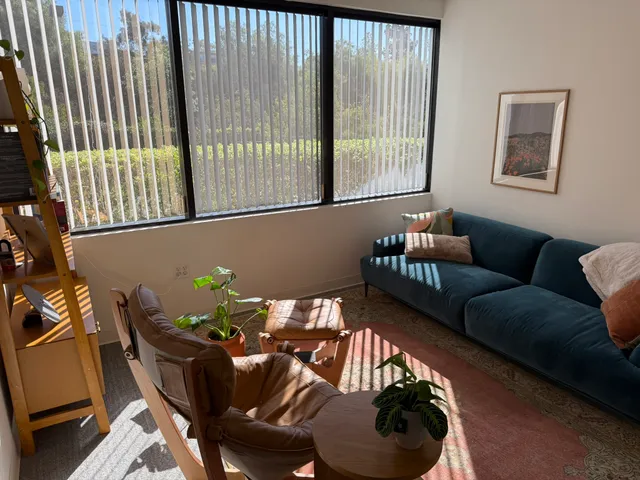
I see EMDR clients in person at Coastal Therapy Group’s Vista office at 1800 Thibodo Road, which is a short drive from Oceanside, San Marcos, Carlsbad, and Encinitas. I also see clients via video telehealth. I am currently the clinician providing EMDR at Coastal Therapy Group, which means I can tell you honestly on a consultation call whether EMDR is the right tool for what you are carrying, or whether something else should come first.
If the thing you have been avoiding is the telling, it is worth knowing that EMDR asks for less of that than almost any other trauma treatment. You do not have to narrate it. You have to be willing to look at it, briefly, with someone sitting beside you while you do.
Sources and further reading
- Francine Shapiro, Eye Movement Desensitization and Reprocessing: Basic Principles, Protocols, and Procedures, 3rd ed. (2018)
- World Health Organization, Guidelines for the Management of Conditions Specifically Related to Stress (2013)
- American Psychological Association, Clinical Practice Guideline for the Treatment of PTSD in Adults (2017)
- Bessel van der Kolk, The Body Keeps the Score (2014)
Frequently asked questions
What actually happens in an EMDR session?
You bring a specific memory into mind along with the image, belief, emotion, and body sensation attached to it. Your therapist then guides short sets of bilateral stimulation, usually eye movements, tones, or taps, lasting roughly thirty seconds each. After each set you say what came up, in a few words. That cycle repeats until the memory loses its charge. You are awake, in control, and can stop at any point.
What does EMDR feel like?
Most people describe it as something between remembering and daydreaming. Images, sounds, body sensations, and other memories surface on their own, often in an order that makes no logical sense. Emotion can rise quickly and then fall away within a set or two. Many people find it tiring in the way a long conversation is tiring, rather than frightening.
Do I have to describe what happened out loud?
Not in detail. EMDR needs enough of the memory to target it accurately, not a full narrative. Some people say very little during reprocessing. If speaking about it has always been the hardest part, that is worth naming early, because it is one of the reasons EMDR suits some people better than talking alone.
Is EMDR ever the wrong first step?
Sometimes. If someone is in an active crisis, in an unsafe situation, or has no reliable way to come back down from distress, reprocessing is not where we start. We build stability first. That is not a delay in the treatment, it is part of it.
Where can I do EMDR in North County San Diego?
Coastal Therapy Group offers EMDR via video telehealth or in person at our Vista office at 1800 Thibodo Road, an easy drive from Oceanside, Carlsbad, San Marcos, and Encinitas. You can start with a free 15-minute consultation.
Thinking about starting therapy?
If this essay resonated, a conversation might help more. Reach out for a free 15-minute consultation. Our care coordinator will match you with the right therapist, with no pressure and no obligation.
The letter
Subscribe to Undercurrent
Each month our psychologist Naomi Wu, PsyD writes a single email: honest reflections from our team, updates on therapy groups forming at our offices, new services, and introductions to the clinicians joining our practice. It's a small way to stay connected to what we're cultivating and building here.
We write once a month, never more.
Working with an Asian American Therapist: What Cultural Understanding Can Make Possible
What therapy with an Asian American therapist can offer, from stigma to family pressure to identity. A psychologist on culturally attuned care.

You Don't Have to Let Them Go
Grieving does not require severing the relationship. Continuing bonds research says the opposite. A Carlsbad psychologist on staying connected to the person you lost.

When Trying Harder Makes It Worse: Understanding Experiential Avoidance
Experiential avoidance is the effort to escape uncomfortable inner experiences, and it quietly drives a lot of suffering. A Carlsbad psychologist explains.