
Weekly adults process group · Two evenings · Vista, CA
A weekly process group for adults in Vista, now on two nights
Real Talk
A therapy group for adults who want to understand how they come across, and change it, with people who will tell them the truth.
This is a clinician-led interpersonal process group, not a class, a lecture, or a drop-in support meeting. Prefer one-on-one for now? We offer individual therapy in Vista too, just ask.
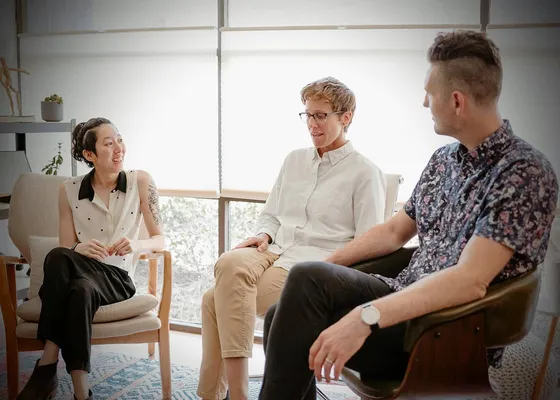
Everything you need to decide, up front
Real Talk runs on two evenings, led by different clinicians. Same format, same office, same work. The night you pick is the main decision.
Pick your night
Two cohorts, same group.
Both meet weekly for 90 minutes at our Vista office, both cap at 10 members, and both do the same interpersonal process work. Both cost $80 per session. They differ on two things: the night and who leads it.
Mondays
Meets 6:00–7:30pm
- Led by
- Sean Noe, PhD & Bethany Ling, PsyD
- Training
- Postdoctoral fellows, supervised by licensed psychologists
- Size
- 5–10 members, adults 18+
This cohort is established and running, and a couple of seats have just opened.
Ask about a Monday seat →Tuesdays
Will meet 5:30–7:00pm
- Led by
- Jenna Suway, PhD
- Training
- Licensed psychologist
- Size
- 5–10 members, adults 18+
Has not met yet. Joining now means being part of the first cohort.
Reserve a Tuesday spot →Not sure which night? Say so on the form. We’ll talk it through and help you land on the night that fits. Curious who leads each night? It’s answered plainly in the FAQ.
Does any of this sound familiar
You might relate if…
- 01 Your friendships start strong… then fade
- 02 You overthink how you come across
- 03 You people-please, then feel resentful
- 04 You feel like you’re either too much or not enough
- 05 You don’t fully understand how others experience you
- 06 You’re functioning fine on the outside and still feel alone
There’s nothing wrong with you. There’s just a pattern, and patterns can change.
The reason it feels scary is the reason it works.
How the work actually works
This isn’t just talking about your life.
Most therapy happens in isolation. You talk about your relationships with someone who wasn’t there. You describe how you come across, based on your best guess. You work on patterns from the outside. Real Talk works differently: you’re not just talking about your life, you’re living a slice of it in the room. The way you show up here is the way you show up with your coworkers, your partner, your friends, your family. That makes it the rare space where your patterns are actually visible, not just remembered.
Process group, skills group, or individual therapy?
A process group fits if you want ongoing connection with other adults alongside clinical guidance, and you’re ready to be seen by others rather than only heard one-on-one. A skills group like our DBT skills group fits if you want concrete tools and a curriculum. Individual therapy is private and built entirely around your own history and pace. Many people do more than one. If you’re not sure, say so on the form and we’ll help you sort it out.
What happens in the room
- 01 You don’t just talk about relationships, you have them in real time
- 02 You see how you show up with other people in the room
- 03 You get honest, caring feedback about how you come across
- 04 You start to understand your patterns while they’re happening
It can feel uncomfortable at times. That’s usually the moment something changes. It’s not about performing, and it’s not about forcing vulnerability. It’s about building enough trust to take a real risk in front of other people.
What people get from group therapy
Growth that happens live.
A 25-year meta-analysis led by Gary Burlingame and colleagues found group therapy performs on par with individual therapy across a wide range of concerns. For relationship patterns specifically, group offers something individual work can’t: other people to practice with. Over time, members often experience:
- Less loneliness
- More emotional confidence
- Clearer boundaries
- Deeper self-trust
- A greater capacity to give and receive support
- More honest, more fulfilling relationships
And maybe most importantly: the sense that people can know you as you actually are.
Is this the right fit
Who Real Talk is for.
A good fit if
This is your speed.
- You’re an adult (18+) open to looking at your relationships honestly
- You notice repeating patterns like conflict, avoidance, people-pleasing, shutdown
- You’ve done enough self-reflection to know that how you relate to people is a recurring theme
- You want more than insight. You want to see yourself from the outside and try something different
- You can commit to the same evening every week, not just when it’s convenient
Not the right fit if
A different kind of support fits better.
- You’re in active crisis and need stabilization or a higher level of care first
- You’re looking for advice, worksheets, or a structured curriculum
- Neither Monday nor Tuesday evenings work and you can’t attend consistently
- You’d rather process privately in one-on-one therapy for now
Not sure where you land? That’s exactly what a free conversation is for.
Before your first session
Feeling nervous is completely normal.
Almost everyone hesitates before their first group, especially if they’ve never done one. If you’re worried you’ll say the wrong thing, feel awkward, or not know what to say, you’re describing what most members felt walking in.
- You don’t have to share everything right away
- You will never be pushed to talk before you’re ready
- Your group leader guides the process and keeps the space respectful
- Most people leave the first session relieved they came
The practicals
How the group works.
Both cohorts run weekly at our Vista office, just off the 78 in North County San Diego. These are the facts that hold for either night.
At $80 per session, group is one of the most affordable ways to work with a doctoral-level clinician at our practice, and a fraction of what individual therapy costs here. You can attend it on its own or alongside individual therapy. For how private-pay and out-of-network reimbursement work, see our cost and insurance page.
Meet your group leaders
Warm, direct, and easy to talk to.
Every Real Talk cohort is led by a doctoral-level clinician from our Vista office. Who you get depends on the night you choose.
Mondays 6:00–7:30pm · $80 / session

Sean Noe, PhD (he/him)
Postdoctoral Fellow
Dr. Noe draws on psychodynamic and attachment approaches, with particular interest in identity, meaning, and life transitions. He brings a steady, thoughtful presence to the group.
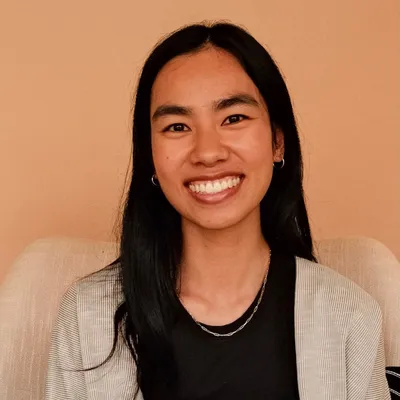
Bethany Ling, PsyD (she/her)
Postdoctoral Fellow
Dr. Ling works with curiosity, empathy, and respect for each person’s story and identity, with specialized experience in trauma and cultural identity.
Both are postdoctoral fellows: they have completed their doctorates in clinical psychology and are accruing supervised hours toward licensure, with ongoing supervision from licensed psychologists on our team. In practice that means a second doctoral-level clinician is also thinking about the group.
Tuesdays 5:30–7:00pm · $80 / session
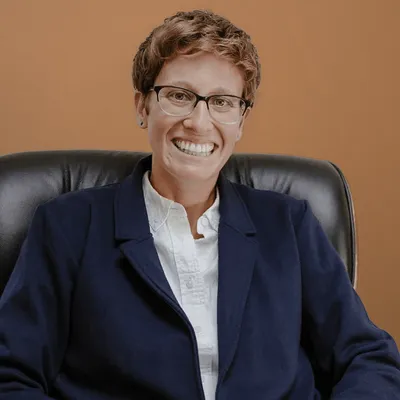
Jenna Suway, PhD (they/them)
Licensed Psychologist
Dr. Suway is a licensed psychologist at our Vista office. Their approach is integrative, with a strong focus on psychodynamic work and a multicultural perspective, which is to say they’re less interested in managing your symptoms than in understanding what keeps producing them. They also lead our DBT skills group and The Queer Umbrella.
“People aren’t cookies, so I don’t use a cookie cutter model for therapy. Instead, I provide individualized therapy tailored to your unique history, capacities, and needs.”
Good questions
What people ask before the first call.
01 What is a process group, exactly?
A process group is a small therapy group where the focus is on what’s happening between members in the room: the patterns, reactions, and dynamics as they unfold. Instead of rotating through individual check-ins or working from a lesson plan, members bring whatever is alive for them and use the group itself as the material. Over time, you start to notice how you relate, what you avoid, and what you’re capable of when someone gives you honest feedback.
02 How is this different from other therapy groups?
Many therapy groups are psychoeducational or skills-based, so you learn coping tools, do worksheets, or follow a curriculum. Real Talk is not that. It’s an interpersonal process group, which means the work is relational and experiential. You’re not preparing for relationships. You’re practicing them. If a curriculum is what you’re after, our DBT skills group is the better fit.
03 Why are both nights called Real Talk?
Because they’re the same group in every way that matters: the same format, the same office, the same 5 to 10 adults per cohort, the same interpersonal process work. What differs is the night and who leads it. Naming them separately would suggest they’re different products, and they aren’t. Real Talk is simply what we call adults process group work at Coastal Therapy Group, and as we add nights, they’ll carry the same name.
04 Which night should I pick?
Start with what you can actually commit to every week, because consistency matters more than any other factor here. Beyond that: the Monday cohort is established and running, so you’d be joining a group that already has its footing, and a couple of seats are open right now. The Tuesday cohort hasn’t met yet, so you’d be there from the first session and helping shape the group from the start. If you genuinely don’t mind either, say so on the form and we’ll talk through which one fits you best.
05 Who leads each night?
The Monday cohort is led by two postdoctoral fellows, Dr. Sean Noe and Dr. Bethany Ling, who have completed their doctorates and are accruing supervised hours toward licensure, with ongoing supervision from licensed psychologists here. The Tuesday cohort is led by Dr. Jenna Suway, a licensed psychologist. Both are doctoral-level clinicians, both cohorts run the same way, and both cost $80 per session.
06 Is there room in the Monday group right now?
Yes, a couple of seats. Process groups work partly because membership is stable, so we keep them small and don’t oversubscribe them, which means openings come and go as members finish their work. Right now Monday has room. The next step is a free consultation with the group leaders, so that joining an established group feels considered rather than abrupt. If Monday fills before we talk, the Tuesday cohort is forming and has room.
07 Do I need to be in individual therapy to join?
No. Some members do both, and group and individual therapy tend to reinforce each other. Others find group is exactly what they need right now. During the free consultation, your group leader will help you figure out what makes sense for where you are.
08 Do I have to talk?
Not right away. Sharing is encouraged, but nobody is pushed to speak before they’re ready. Most people listen more than they talk at first, and that’s expected. You can start by listening, share at your own pace, and let trust build.
09 What does a typical session look like?
There’s no agenda. Sessions begin, and members bring what’s on their minds: what’s happening in life, what’s happening in the group itself, or something they noticed about themselves since last week. Your group leader helps the group stay with the relational work that makes process groups powerful.
10 How long do members usually stay?
Most members stay at least six months, and many stay a year or more. Change in group therapy is cumulative. The longer you stay, the more visible your patterns become, and the more room you have to try new ones.
11 Is everything confidential?
Yes. Every member agrees to confidentiality before joining, and that agreement is central to how the group functions. You’ll go over exactly how confidentiality works during your consultation.
12 How much does it cost, and do you take insurance?
Real Talk is $80 per session on either night, paid weekly. That’s a fraction of what individual therapy costs at our practice. Coastal Therapy Group is a private-pay practice and out-of-network with all insurance plans, but we provide monthly superbills you can submit to a PPO for possible reimbursement. See our cost and insurance page for details.
13 What if I try it and it’s not for me?
That happens, and it’s fine. The consultation exists so you can figure that out before you commit. Once you join, we ask for consistency, but if you decide the group isn’t serving you, you and your group leader will talk about it directly and sort out the right next step.
Ready when you are
Interested?
Real Talk runs on two evenings in Vista, CA, at $80 per session. The Monday cohort meets 6:00–7:30pm and has a couple of seats open right now. The Tuesday cohort will meet 5:30–7:00pm and is forming now, which means joining it makes you part of the first cohort.
The next step is the same either way: fill out the form below and tell us which night you’re after. We’ll follow up to answer your questions, make sure it’s the right fit, and share next steps. No pressure, just a conversation.
Ask about a seatTalk
Tell us which night.
Fill out the form and a real person from our team will reply, usually within one business day. The Monday cohort has a couple of seats open. The Tuesday cohort is forming now and has room. Prefer to talk first? Call or text (760) 334-6262.