
10
Is it religious trauma if you loved church? With Cheyenne Garstad, LCSW
Therapist Cheyenne Garstad, LCSW, on why religious trauma is rarely the reason people start therapy, how good memories hide it, and rebuilding community.
Episode 11 · 48:50
Where Did Your Mind Just Go?
David Wang, PhD, on why trauma is so hard to name, why the culture gap is often a trauma gap, and what real post-traumatic growth sounds like.

Dave Wang’s grandfather was a general for Chiang Kai-shek, and fled mainland China for Taiwan about eighty years ago. He had PTSD. It shaped the way he parented Dave’s father, and that shaped the way Dave was parented. Dave was born on the other side of the world, and he still had to find his way through fragments of a trauma he did not yet know to call by that name.
In this episode, Dr. Gabriel Lowe sits down with David Wang, PhD, the Cliff and Joyce Penner Chair for the Formation of Emotionally Healthy Leaders at Fuller Seminary. He is also a Senior Research Fellow at the Nagel Institute for the Study of World Christianity at Calvin University and an Affiliate Scholar at the Dallas Willard Research Center, and he holds a ThM alongside his doctorate in counseling psychology from the University of Houston. He taught Gabe’s trauma class in grad school. These days Gabe calls him a dear friend, a mentor and a colleague.
Dave came to trauma in grad school, at a practicum placement in the veterans hospital in Houston. Early on he worked with the families of trauma survivors as well as the survivors themselves, running a weekly psychoeducation class for relatives, and that is what turned the work back toward his own story.
That really helped me see my own life story and the story of my extended and intergenerational family more accurately.
The PTSD diagnosis did not exist until the Vietnam War era, Dave points out, and our understanding of trauma has been shaped by that one form of it ever since: young adult men in life-threatening combat on the other side of the world, with a clear start date and a clear end. It put trauma on the map. But trauma involving children is different. So is trauma at the hands of people you are supposed to trust, which is nothing like being shot at by someone you have no relationship with at all.
Gabe names the two ends of the problem. Some people minimize what happened to them, and he admits he does it himself: it’s not that bad, it’s not as bad as what other people went through. Others see trauma everywhere.
Dave says the question plagues the whole field. There are formal definitions, and he reads one aloud, an older diagnostic wording about being exposed to actual or threatened death or serious injury. It is a good starting point, he says, but there is a lot more he wishes were there, because trauma has a subjective element. Two people can go through the same event and come away very differently, and even among people who are traumatized, the symptoms can look nothing alike.
For people who minimize, the language of trauma can be a gift. It lets them give proper honor to what happened. At the other end is the friend whose barista got the coffee order wrong, and who calls it traumatizing. Dave does not want to dismiss that person either, but the word needs some boundaries. Used for anything under the sun, it loses its meaning.
Gabe suspects shame sits under the minimizing, the embarrassment of putting yourself in that group. As for the people who use the word for everything, he guesses they learned it somewhere. Maybe something real happened, and now anything that stirs up those same feelings in the body gets the same name.
Underneath the labeling, Dave says, there is usually a bigger question: why did this happen, and whose fault was it? Most trauma, he thinks, comes from being in the wrong place at the wrong time, or being born into a certain family. Still, nearly all of us do mental gymnastics to conclude that we were somehow responsible. If I had seen it coming, it would not have happened, so next time I will be more careful. For many people, the liberating thing to hear is that they did not do anything to contribute to it.
That brings its own threat, though. If I cannot blame myself, the world is chaotic, and how do I protect myself? And there is another group who know very well it was not their fault, and the conversation they need is different. That may certainly be true, Dave tells them, and whether we like it or not, we still have to take responsibility for the cards we were dealt.
Gabe brings it close to home. There were things he said to his now-wife out of his own traumatized places, things he is not proud of, and they needed repair. Working out who is responsible for what is hard, he says, and then comes the repair itself. Dave calls trauma an invitation to a lot of inner work: noticing the ways we leak out and act out, and asking what that means for who we think we are.
Am I willing to face some of the skeletons in my closet so that I can really be and embody the person that I would like to be?
In its early days, Dave says, PTSD was classed as an anxiety disorder. When the trauma involves strangers, it is easier to treat it as a matter of fear and avoidance, which is why most evidence-based trauma therapies have some kind of exposure component. Complex trauma does not fit so neatly. It disrupts your worldview and your relationships. You start to wonder whether you can trust anyone, including yourself.
He likes the name betrayal trauma for it. The people who cause it have access to us because we trust them, as family or as part of our community, and that trust is exactly what they use to do harm. So there are more layers to work through: past the avoidance, into existential and relational questions. It is a lot trickier, he says, although recovery is still possible.
Gabe hears the language of deconstruction in it, the way people leaving religious trauma talk about a worldview being challenged or completely obliterated. That is far more, he says, than getting back in the car after an accident.
Dave widens the frame. Trauma can disorient us physiologically, which is why he mentions The Body Keeps the Score and insists that treatment has to take the body seriously. The work has to become embodied at some point. Childhood trauma disrupts how the brain develops. It disrupts our relationships and our capacity to cope with emotion, and for people to whom faith matters, there is an emerging literature on how it disrupts spirituality too. He describes a clinical trial of trauma-focused cognitive behavioral therapy he was part of in Haiti, with child survivors of trafficking, and the conclusion his team drew: the different parts of a life that trauma disrupts each need dedicated care.
Gabe asks how Dave came to place himself in his own family’s history. Dave grew up in a Chinese American family he is very proud of and grateful for, and he was used to hearing about the generation gap, or the culture gap. Asian Americans straddle multiple worlds, adjusting to one culture at school and another at home. He calls them chameleons, and bridges between cultures.
The more I’ve reflected on that in my own life, the more I’ve realized that a big part of the culture gap is actually a trauma gap.
Children of immigrants are bridging traumas, he says, recent ones and ones far back in the family line. People often migrate because they are fleeing trauma and looking for opportunity, and the move itself can be traumatic. Then, in a country that was not created for you, you are vulnerable to a whole other set of traumas.
The common theme is survival. When we act out in ways we do not expect, it usually makes sense if you dig deep enough: we are doing what helped us, or our families, survive. The trouble comes when circumstances improve and we keep living as if we are in crisis. That keeps us stuck in survival when thriving has become possible.
Gabe notes that you cannot bill insurance for collective trauma, and that we have much more language for individual trauma than for the generational, national or political kind. Dave says even having terms like collective trauma helps, though the research is preliminary and sometimes speculative. It is hard to study intergenerational dynamics empirically. “Bring the whole family to the lab,” Gabe offers. There is no time machine, Dave answers, to go back eighty years and watch it unfold.
Still, he suggests that every social group, whether a culture, a nation or an ethnic group, has its own collective trauma history. His example is the Civil War. The country is still struggling with its memory, people do not agree on the details, and different regions tell different stories about it. These are all common features of trauma, he says, and if we do not find the courage to face the beauty and the brokenness of our stories, individually and collectively, we are doomed to repeat them. He thinks the country is repeating some of that now, and tells listeners they do not have to agree with him.
Gabe names the fear and the anger many people feel about the political moment, and how outrage can bury the grief and fear underneath it until people slide toward hopelessness. How do you stay honest about what is happening without falling into despair?
Dave answers with what therapists see in individuals. One avoidant response is triumphalism: we overcame, we won, end of story. Real stories almost never go that way. They are almost always a combination of beauty and brokenness, and surviving and growing do not cancel out the grief and loss. The opposite response, getting stuck in hopeless rumination, does not help either. Both can play out at the scale of a country.
He adds a term he learned from colleagues: trauma vows. After we are hurt, we often promise ourselves, out loud or not, that we will never let ourselves get hurt like that again, or never let anyone that close. A country can make the same vow, and spare no expense to stamp out any threat. That kind of thinking, he says, gets used to justify things that should not be justified, things that end up traumatizing others. It is the collective version of something true of individuals: trauma that has not been dealt with puts us at risk of traumatizing other people.
Gabe has been carrying a line he credits to Richard Rohr, and paraphrases it: with trauma, you either transmit it or transform it. Rohr’s own wording, from a 2018 meditation, is that if we do not transform our pain, we will most assuredly transmit it. Dave has a principle he returns to more and more as he trains future therapists: what comes in must come out.
It has to go somewhere. It’s not gonna just disappear if we ignore it.
Either it is transformed, he says, or it comes out in ways that retraumatize and harm other people. There is really no middle ground.
Gabe hears a kind of machismo in a lot of his clients, and a little in himself: it doesn’t bother me, I’m stronger than it, I can press it down. Nobody wants to feel weak. But does the stoicism keep you from dealing with the hurt, so it comes out in ways you do not recognize?
Dave describes his relationship with stoicism as ambivalent. Its idea of nonattachment invites useful questions, like why you care so much about what people think of you, and he calls that gold. Applied too rigidly, though, it leaves no room to be human. People are punching you in the face and you are supposed to have no emotion. “Dude, you know, you’re still a human being, man.”
On a more basic level, he separates the ideal from the reality. You are free to endorse the stoic ideal or not. Either way, it did affect you.
Whether you should be hurt or not is another topic that we can discuss at some point in the future. The reality is that you are hurt, and since you are hurt, let’s figure out a way to tend to it and to navigate it.
Jump to the stoic part too early, he says, and what you end up with is denial and avoidance.
Clients ask Gabe how long this will take. How long until the nightmares stop, how long until they are not scared of this person anymore. He admits there can be impatience on the therapist’s side too, a wish to hand over the coping skills and get everyone bandaged up.
Dave suspects this comes partly from modern self-help culture, which expects us to be formed into virtues more or less instantly once we have the insight, as if having the words for something would form the substance of it. His example is humility. You can learn about it, study it and pursue it, and know a great deal about it, and still not be humble.
There’s nothing that teaches humility better than humiliation.
It is not fun, he says. You get humiliated and you have to work through it and see what comes up. He cannot shed his imperfect attachments by willpower or knowledge alone. He has to go through the wringer.
Some things only move at the speed of life.
Education and insight still matter. They give us language and a sense of direction, an idea of what the goal might look like. But we still have to make the journey, and it takes repetition. Grief is the clearest case. We might know the stages, and know that we are trying to get to a place of accepting the loss and starting a new life. We still have to do the work, brick by brick.
I can certainly make this process a lot longer than it needs to be, but I don’t think I can make it any shorter than it needs to be.
Gabe raises what some researchers have called post-traumatic growth. Some of the most transformative times in a life are also among the most painful. How do you talk about growth without turning trauma into a means to an end?
Growth after trauma is real, Dave says. It is not only a return to normal; people can surpass where they were before. But even when growth is there, it rarely if ever justifies the original trauma. And for people who have genuinely grown, it is never triumphalistic. Through the humiliation they cultivate humility, and they start to sound like the Serenity Prayer, usually credited to Reinhold Niebuhr (its authorship has been debated). He shares it with clients whether or not they are religious, because the principles are so human: the serenity to accept the things you cannot change, the courage to change the things you can, and the wisdom to know the difference. Post-traumatic growth, he says, is often growth in exactly that.
When he bears witness to that growth, he sees some of the best of humanity: people who went through horrific things and somehow metabolized them, and came out more in touch with their own humanity and other people’s. Some are among the most generous, compassionate people he knows. What would make most of us bitter produced very different fruit in them.
Genuine, substantive post-traumatic growth never sounds like that.
By “that” he means the bootstraps story: I won, I emerged victorious, I conquered my trauma. Growth sounds more like learning that you are not entitled to anything in this life. Good things happen to bad people and bad things happen to good people, life is unpredictable and fragile, and you still have to take responsibility for what you can control. Just as the bad thing was not entirely your fault, the good things were not entirely earned. What is left is to treat them as gifts, and to be grateful for the big things and the small ones.
Gabe finds that paradoxical, something that sounds imprisoning turning out to be freeing. He is not knocking the idea that everything happens for a reason, only the way it can close us off to chaos and to what we cannot understand. Dave adds another shape growth can take: ambiguity tolerance. I have some hypotheses about why this happened, but ultimately I’m not sure. Not jumping to premature conclusions, he says, is freedom from another kind of prison we build for ourselves.
Gabe’s last question picks up Dave’s phrase. Bearing witness, as a therapist, a friend or a stranger, is humanizing. But with genocides around the world and thousands of people being trafficked, it can feel trite. Is it enough, and what does it look like to go further?
Dave says he is still figuring that out. Genocide, racism and the rest are bigger than any one person. They are group and societal processes, and an individual may not have the power to change them alone. So he comes back to the same prayer: accept what we cannot change, change what we can, and do what we can with what we have and what we know at this moment. Bearing witness is necessary regardless. We would not know which modest steps might help unless we first bore witness to all of what is going on, including what is going on in our own hearts. In our fervor and anxiousness, he says, it is very common to do something that makes things worse.
When I think of doing good and contributing to the good of the world in a sustainable way, it necessitates a lot of listening and bearing witness first.
If something here sounds like your own story, including the part where you are not sure it counts, our doctoral-level clinicians offer trauma therapy, EMDR, and psychodynamic therapy for the patterns that started long before you did, in Carlsbad, Encinitas, and Vista and online across California. If you would rather talk with someone who knows the bridge between home and everywhere else, we also have Asian American therapists. A free consultation is an easy first step. And there are more conversations like this one across Where Did Your Mind Just Go?
Where Did Your Mind Just Go? is a production of Coastal Therapy Group. This episode was edited by Serena Rio.
The host
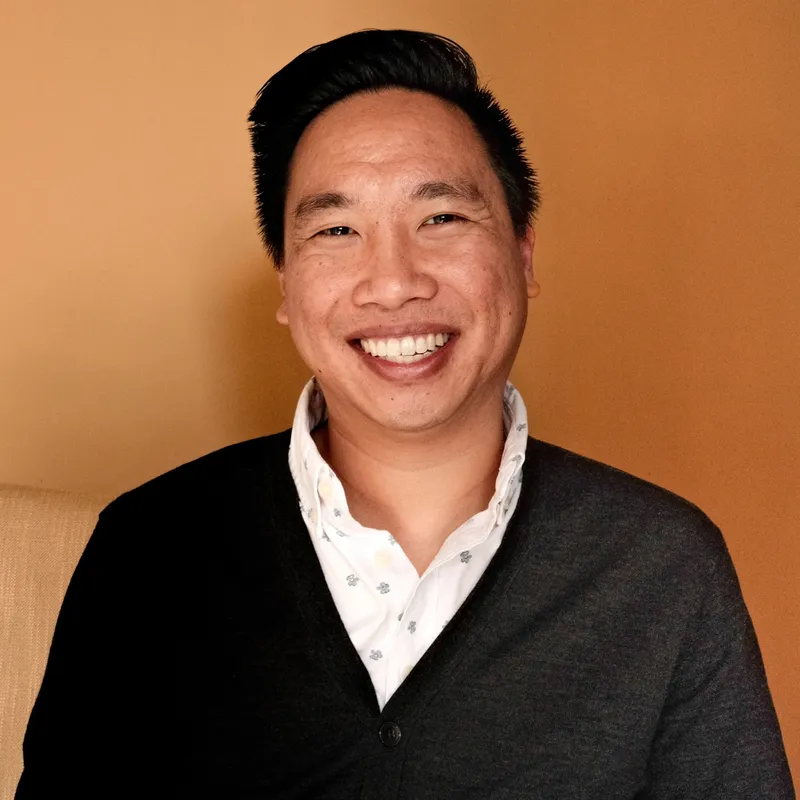
Dr. Gabe Lowe is a psychologist and the creative mind behind Where Did Your Mind Just Go? — a passion project born from a belief that the world needs more spaces where curiosity and uncertainty are embraced, not solved away. Each episode, he brings his gift for deep listening and unhurried conversation to topics that matter, sitting across from bright, thoughtful minds and following the dialogue wherever it wants to go.
Where Did Your Mind Just Go?
10
Therapist Cheyenne Garstad, LCSW, on why religious trauma is rarely the reason people start therapy, how good memories hide it, and rebuilding community.
09

Psychologist Anjali Ferguson, PhD, on why kids notice race by six months, why the adults are the ones who aren't ready, and raising proud, safe kids in a hard year.
08
Psychologist Christopher Schadt, PsyD, on making mental health content, what the algorithm rewards, parasocial trust, and the harm in five easy steps.
Follow the show
New episodes drop the first and third Wednesday of the month. Follow the show on your platform of choice, or get an email when one lands.
Or follow on Apple Podcasts Spotify
If the episode left you with better questions about your own life, we can sit with those too. Book a free consultation, or call or text (760) 334-6262.