10
Is it religious trauma if you loved church? With Cheyenne Garstad, LCSW
Therapist Cheyenne Garstad, LCSW, on why religious trauma is rarely the reason people start therapy, how good memories hide it, and rebuilding community.
Episode 6 · 56:29
Where Did Your Mind Just Go?
Psychologist Christina Lee Kim, PhD, on working motherhood, what good enough really means, the mental load, and learning to name your own limits.
Almost everyone carries a private picture of what a good mother looks like. It usually arrived before we were old enough to vote on it, and it tends to show up loudest at the exact moment we fall short of it — the forgotten pickup, the missed recital, the choice to go back to work or not to.
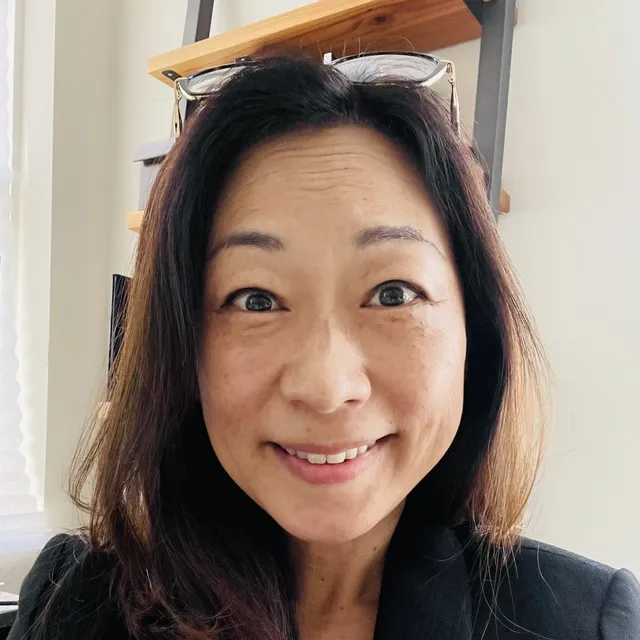
In this episode, Dr. Gabriel Lowe sits down with one of his own former professors, Christina Lee Kim, PhD, a licensed clinical psychologist, associate professor, and associate dean at Biola University’s Rosemead School of Psychology, where she also chairs the undergraduate psychology department. She contributed a chapter called “The Good Mother” to Power Women: Stories of Motherhood, Faith, and the Academy, a collection that grew, fittingly, out of a group of Biola faculty mothers who started meeting for lunch because they needed somewhere to put all of it.
The conversation starts further back. Christina found psychology as an undergraduate at UCLA, briefly defected to elementary education for about two weeks, and came back. What actually decided graduate school for her was a job. She was doing early intervention work with preschool-aged children with autism, driving out to homes in Bel Air and Brentwood, and at some point she learned what those families were paying and how long the waitlist was. The thought that followed sat on her chest: what happens to a family who cannot afford this, or cannot navigate the system in English, or never hears the program exists at all? Her own parents had immigrated from South Korea without much English. The question was not abstract.
One of the ideas she takes from the book is a small vocabulary change with a lot behind it. A colleague’s chapter argues for retiring work-life balance in favor of something closer to enhancement: the premise that being a professor can make her a better mother and that being a mother can make her a better professor, rather than two weights on a scale, one of which has to drop for the other to rise.
That framing does not make the tensions disappear. Christina is candid about the arithmetic of an academic career with babies in it — the years when a research program is supposed to get built, the licensure exam she assumed she would study for during maternity leave and was far too sick to touch. She was not licensed until nearly nine years after finishing her degree. Things went to the back burner, and stayed there a while.
Her mother turns out to be the surprise in the story. Christina had assumed she would be the one urging her to stay home. Instead: I didn’t raise you so that you could get this degree and then give it all up once you had babies. And then, immediately: if you need help, I’ll watch them. It is one of those moments where an inherited script gets handed back rewritten, and Christina reads it generously — through her mother’s eyes, through what an immigrant family gave up so their daughters could be educated in the first place.
She and Gabriel also stay honest about what has not evened out. Her husband works from home and is, by her account, more involved than most fathers she knows. And she still carries a wildly disproportionate share of the mental labor: the schedule, the dinner, the thing that has to be bought before the winter recital. What has helped is unglamorous — a shared calendar, and agreeing out loud who owns which domains.
The part of the episode that opens widest is about capacity. Christina notices that the working women in her life tend to be enormously competent, high-output, on top of things — and that the same competence can quietly become a wall. Her church language for it is self-sufficiency versus spirit dependency. In plainer terms: doing everything under your own power is applauded right up until it exhausts you, and she is not convinced exhaustion leads anywhere good.
She learned that the way most people do. There was a semester where she was sick, more or less continuously, to the point where students started asking if she was okay. What she remembers is not the illness but the strange tenderness of it — being made to notice that she had a body with limits, and building, that semester, a list of small daily practices that took those limits seriously. Not a spa day. Something more like permission.
Around the same time she got stuck on a verse she had always liked and suddenly could not make sense of: come to me and I will give you rest, followed immediately by take my yoke. Rest and then a yoke. She prayed about it for weeks before the reframe came.
I think my massive blind spot was recognizing that I’m not a free bird. I am actually yoked by all the expectations I place on myself.
There is a companion insight from her spiritual director, who asked how she prays and then gently pointed out that her prayers were all requests for tools — wisdom, strength, the resources to go handle it herself. What if the question instead were: where are you already working, and where can I join you? A prayer of empowerment versus a prayer of engagement. Gabriel adds a distinction from Galatians that runs parallel: we are told to carry each other’s burdens, the crushing things, and also to carry our own load, the manageable share that belongs to each of us. Neither crushed nor exempt.
Gabriel eventually names the theory hiding under her chapter title: Winnicott’s good enough mother, the idea that a parent’s ordinary misses are not damage but material — the way a child learns that the world is imperfect and survivable. Christina takes it further into practice. She over-functioned when her kids were small, tying shoes herself because it was faster than waiting twenty minutes. Now she is deliberately slower, letting them fail at things on their own clock.
The proof arrived recently. Her husband was out of town, she was at her desk, not even busy — just blank — and her fourth grader called from school asking where she was. The girl had walked home, used the door code, called her mother. She did everything right. And Christina, who was left waiting outside her own school for forty minutes at a time as a kid — memories her mother, notably, does not have at all — got to watch the thing she had promised never to repeat happen anyway, and be fine.
They close on the two questions that hold the rest together. How do you steward a life with this many plates spinning? Her answer is seasons: the recognition that what you are called to now is not what you will be called to in ten years, that she once dropped to seventy-five percent time for a stretch and it helped, that she is squarely in the Erikson years where pouring into the next generation is the point. And what would she tell someone younger trying to hold all of it? Don’t compare. Every single time she has measured herself against a colleague’s promotion timeline, it has drained the joy straight out of the work.
That, more than any framework, is the shape of this one: not a system for getting it right, but a long look at where our standards for “good” actually came from, and what it costs to keep meeting them alone. If it lands close to home, our clinicians write about neighboring territory in therapy for professionals and executives, faith-integrated therapy, and working with an Asian American therapist — and there are more conversations like this one across Where Did Your Mind Just Go?
Listen to the full episode Spotify Apple Podcasts YouTube
Where Did Your Mind Just Go? is a production of Coastal Therapy Group. This episode was edited by Serena Rio.

The host
Dr. Gabe Lowe is a psychologist and the creative mind behind Where Did Your Mind Just Go? — a passion project born from a belief that the world needs more spaces where curiosity and uncertainty are embraced, not solved away. Each episode, he brings his gift for deep listening and unhurried conversation to topics that matter, sitting across from bright, thoughtful minds and following the dialogue wherever it wants to go.
Where Did Your Mind Just Go?
10
Therapist Cheyenne Garstad, LCSW, on why religious trauma is rarely the reason people start therapy, how good memories hide it, and rebuilding community.
09
Psychologist Anjali Ferguson, PhD, on why kids notice race by six months, why the adults are the ones who aren't ready, and raising proud, safe kids in a hard year.
08

Psychologist Christopher Schadt, PsyD, on making mental health content, what the algorithm rewards, parasocial trust, and the harm in five easy steps.
Follow the show
New episodes drop the first and third Wednesday of the month. Follow the show on your platform of choice, or get an email when one lands.
Or follow on Apple Podcasts Spotify
If the episode left you with better questions about your own life, we can sit with those too. Book a free consultation, or call or text (760) 334-6262.